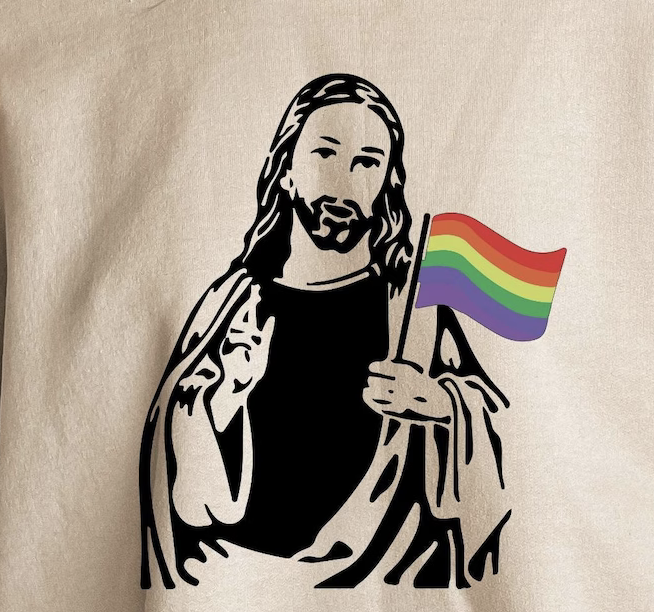
Tough Call

Upon my retirement I had to clean out my study at the church.  In addition to the mountain of paper files and moldy sermon manuscripts that went into the recycle bin I found a stack of plaques and resolutions that had been languishing in the back of a closet.  Many of them were from boards of directors on which I had served through the years, and a few were framed resolutions declaring gratitude for one thing or another. (You know the kind of thing: lots of WHEREAS’S and THEREFORE-BE-IT-RESOLVED’S.) 

The entire pile when into the dumpster – except for one item: the Voice for Equality Award presented by Equality Florida, the preeminent voice for LGBTQ+ citizens in the Sunshine State.  I was presented the award after years of testifying before legislative committees and writing opinion columns for the Tallahassee Democrat and other newspapers.  In those communications I argued for the full inclusion of LGBTQ+ folks in the life of the republic and against discrimination fueled by homophobia.  

What makes me an advocate in this area is my Christian faith.  I believe that all people, regardless of their sexual orientation or gender identity, are created in the image of God and should be treated with dignity, compassion, and respect.  The dual command to love God and neighbor requires no less from followers of Jesus Christ.  

What’s more, I am convinced that the command to “do justice, love mercy, and walk humbly with God” prompts Christians to pay particular attention to people on the margins of society, which include the poor, the outcast, and the victims of hatred – those whom Jesus termed “the least of these.”  To walk alongside people who have been “buked and scorned” is to walk with Jesus. 

As I pastor, I saw the harm that homophobia causes.  I counseled young people who became estranged from their families for coming out as gay or lesbian, and I have seen the struggle that people go through when they don’t feel at home in their own bodies.  These are my siblings in Christ.

I must admit, however, that I am conflicted regarding the recent decision of the Supreme Court in favor of a web designer who objected to making wedding sites for same-sex customers.  It appears to me that the web designer Lorie Smith was acting out of sincere religious conviction and that she has a right to decline services to same-sex customers.  

Of course, I don’t agree with Lorie, my sister in Christ.  I think she’s mistaken, but I also think that a web design business is not the same as a public accommodation.  If Ms. Smith owned a restaurant and refused to serve same-sex couples, or if she ran a hotel and refused to allow same-sex couples to stay in her hotel, I’d feel differently.  

It occurs to me that having someone design your webpage does not rise to the level of a basic human right.  As galling as it must have been to the same-sex couples who wanted to use Ms. Smith’s services, I can’t see why they can’t avail themselves of another web designer who would be happy to work for them.  I imagine there are plenty of web designers out there who would welcome the business.  

Freedom of religion cuts both ways.  I respect Ms. Smith’s right to live in accordance with her faith.  Who knows?  Maybe she feels the same about me. 

Thank God same-sex couples can legally marry and thank God we live under a constitution that protects the free exercise of religion.  

It pains me to say it, but I think the Supreme Court got it right this time.  

Read no further . . .

My father, H. Richard Copeland, attended Austin Theological Seminary in the late 1940’s.  He was fond of telling stories about the seminary’s president at the time, Dr. Robert Gribble.  Dr. Gribble was an Old School Presbyterian and zealous guardian of Calvinist orthodoxy.  He was also keen to keep up appearances.  According to my dad, Dr. Gribble was aware that his wife’s love of dancing bordered on the scandalous – at least in the minds of the most frigid among the Chosen Frozen – and he took pains to keep other signs of impropriety from public knowledge. 

My parents were in the lobby of an Austin movie theater to see a “picture show” (which in itself was a tad risky) when they spotted Dr. Gribble enter the lobby and approach the Coke machine.  He surreptitiously removed a brown paper bag from his pocket, inserted a nickel in the slot, and pulled the lever on the machine.  Out came a glass-bottled Coca-Cola.  Dr. Gribble quickly shoved the bottle into the paper bag and stuck the bag into the pocket of his jacket. As he turned toward the exit, he spotted my mom and dad.  Blushing deeply, he shook his head in disgust and said, “My wife will drink these things,” and hurried through the door.

But that’s not the Dr. Gribble story I meant to tell.  The one that’s on my mind is about the time Dad was in the seminary library reading a book of contemporary theology.  He turned the page to discover a note scribbled in the margin by none other than the seminary’s president. “Stop!” Dr. Gribble had written, “Read no further! This is heresy!”   

Dr. Gribble no doubt had the best of intentions.  He didn’t want future pastors to be infected by unorthodox theology and contaminate the congregations they would one day serve.  His censorship was meant as pastoral care.

Florida’s governor and recently-declared presidential candidate Ron DeSantis couches his efforts at mind control in similar terms.  By limiting what teachers of young children might say to their students about sex or gender identity he is protecting them from the virus of “wokeism.”  His anti-viral protections have been extended to students in middle school, where it is now a violation of state law for school employees to refer to students using pronouns that do not correspond to the student’s sex. 

For Gov. DeSantis and his like-minded colleagues, the best way to handle difficult topics such as homosexuality and transgender identity is not to handle them at all.  Just pretend that they don’t exist – that third graders can’t come from a home with two moms instead of a mom and dad, or that eighth graders can’t feel out of place in their own bodies.  

Granted, these are challenging subjects about which people can disagree, and teachers have plenty on their plates without having to serve as culture-war referees.  Still, the goal of education should be to broaden the mind, not constrict it.  

This approach to education reminds me of the days before the Civil War when states in the South banned books and newspapers that contained abolitionist ideas. The best way to maintain the status quo is to protect people from dangerous ideas. I imagine most forms of censorship can be couched in pastoral terms.

It’s unlikely a student in Florida schools will open a library book to discover a handwritten warning to read no further.  These days it’s a good bet that book was removed from the school library long ago. 

Painful Lessons

After graduating from Southwestern at Memphis (now Rhodes College) and before becoming a “divine” at the University of St. Andrews in Scotland, I taught high school English and Latin in Leesville, Louisiana. I hadn’t taken a single course in education, and I didn’t have a teaching certificate, but I convinced the School Superintendent of Vernon Parish that my double major in Classics and Philosophy would suffice.  Desperate to fill out his roster, the poor guy took me on as a utility player.  

That was back in 1974.  In its wisdom, the Louisiana Legislature had banned any form of sex education in the public schools.  Teachers were forbidden to mention the “S” word or to allow the topic to be discussed in their classrooms.  

That was OK with me.  I wasn’t much older than the seniors in my Latin class and, as much as they might welcome the diversion, my ninth-grade English students had plenty on their plates learning how to write a solid paragraph.  (My goal had been to teach them how to write a convincing essay, but I lowered my sights when I realized that several of them could barely read.)  Adding sex to the curriculum would have been a bridge too far.  

The principal at Leesville High took full advantage of having a single male teacher on his staff.  He assigned me to take up tickets at sports events, to serve as an umpire for girls’ softball games, and to drive the cheerleaders’ Volkswagen minibus to away games.  In these days of hyper vigilance, it’s hard to imagine assigning a young male teacher to such tasks, but that was Louisiana in the 1970’s.  Laissez les bons temps rouler – at least when it came to athletics. 

Back in the classroom, however, more than one Big Brother was watching. In addition to keeping the topic of sex out of the classroom, we teachers also had to make sure we didn’t offend the many students who belonged to conservative Christian denominations, among them Pentecostals, Jehovah’s Witnesses, and the Church of Christ.  Some students were not allowed to celebrate birthdays.  For others it was Christmas.  And depending on the topic, many students were forbidden to attend school assemblies. 

Innocent of any instruction in educational theory or practice that might have made me more cautious, I made it through that year without getting censored or fired.  I didn’t know enough at the time to fear irate parents or lawsuit-leery administrators.  I suppose you could say my naivete kept me safe.

If I were teaching these days, naivete wouldn’t cut it.  I’d have to avoid causing my students discomfort by discussing “divisive” concepts, such as slavery, racial discrimination, and the persistent influence of white supremacy.  A bill before the Florida Legislature (SB 148) declares that a student “should not be made to feel discomfort, guilt, anguish or any other form of psychological distress on account of his or her race.”  

God forbid that white students should feel “discomfort” hearing about slave-holding founding fathers or that black students should feel “anguish” when they view newsreels of the attack at the Edmund Pettus Bridge. 

I used to feel a twinge of “psychological distress” every time I mounted the pulpit at First Presbyterian and looked up at the galleries where enslaved human beings looked down on their “owners.”  

I certainly don’t want the children of any race to be paralyzed by “guilt” or “anguish” for what their forebears did or suffered, but I can’t imagine how anyone can become educated without experiencing at least some discomfort.  

Without pain there can be no enlightenment.