Rendering Too Much to Ceasar

Aaron B. O’Connell is an assistant professor of history at the United States Naval Academy and a Marine reserve officer.  His op-ed in the November 5, 2012 New York Times, titled “The Permanent Militarization of America,” warns that America has not heeded the warnings of President Dwight D. Eisenhower in his famous speech regarding the “military industrial complex.”  We have become a nation of perpetual warfare, and unquestioned support of the military has become the “third rail” of politics.  He writes of his students:

Uncritical support of all things martial is quickly becoming the new normal for our youth. Hardly any of my students at the Naval Academy remember a time when their nation wasn’t at war. Almost all think it ordinary to hear of drone strikes in Yemen or Taliban attacks in Afghanistan. The recent revelation of counterterrorism bases in Africa elicits no surprise in them, nor do the military ceremonies that are now regular features at sporting events. That which is left unexamined eventually becomes invisible, and as a result, few Americans today are giving sufficient consideration to the full range of violent activities the government undertakes in their names.

Regarding the spiritual impact of militarization, Mr. O’Connell writes:

But Eisenhower’s least heeded warning — concerning the spiritual effects of permanent preparations for war — is more important now than ever. Our culture has militarized considerably since Eisenhower’s era, and civilians, not the armed services, have been the principal cause. From lawmakers’ constant use of “support our troops” to justify defense spending, to TV programs and video games like “NCIS,” “Homeland” and “Call of Duty,” to NBC’s shameful and unreal reality show “Stars Earn Stripes,” Americans are subjected to a daily diet of stories that valorize the military while the storytellers pursue their own opportunistic political and commercial agendas. Of course, veterans should be thanked for serving their country, as should police officers, emergency workers and teachers. But no institution — particularly one financed by the taxpayers — should be immune from thoughtful criticism.

I began including Lord’s Day prayers for loved ones in military service shortly after 9/11.  As a child of the Viet Nam era, I wanted to be sure that, in a time of national crisis, we did not demonize those who serve in uniform.  Then came the invasion of Iraq, which I felt was unjustified.  To me, it didn’t matter that I did not support that war.  I felt it was pastorally appropriate to pray for those in danger.

I have become increasingly uncomfortable with that long list of names of military personnel we print in the bulletin every Sunday.  What began as concern for those in harm’s way has become, I fear, an endorsement of perpetual war.  I still want to pray for those in danger, but I wonder if I have unwittingly undermined the Gospel’s message of peace.

I’m open to suggestions.  Is there a better way to pray for those we love without endorsing the increasing militarization of our nation?

A Voter’s Guide for Christians That is Actually Helpful

Normally, I steer away from so-called “Christian voter guides.”  The ones that arrive on the church doorstep unsolicited go directly into the recycling bin.  However, there are always exceptions.

Miroslav Volf, Director of the Yale Center for Faith and Culture, has written an extremely helpful guide for Christians who vote.  He discusses Christian values, the biblical rationale for those values, and the questions that should be asked.  His paper is too long to quote in its entirety, but can be found here. These are the values Volf  thinks should guide Christians. (Everything below is excerpted from Volf’s paper).

0. Christ as the Measure of All Values

The ultimate allegiance of a Christian is to Jesus Christ, the creative Word (become flesh) who enlightens everyone, and the redeeming Lamb of God who bears the sin of the whole world. Christian ought not embrace any practice, no matter how prudent it may seem from the standpoint of national security or national competitive advantage, which conflicts with their allegiance to Christ.

1. Freedom of Religion (and Irreligion)

All people are responsible for their own lives, and they have the right to embrace a faith or way of life they deem meaningful and abandon that with which they no longer identify without suffering discrimination.

2. Education

It is important for all citizens to understand the world in which they live, to learn to reflect critically on what makes life worth living, and to acquire qualifications for jobs that increasingly require complex skills. We should strive for excellent and affordable education  for all citizens.

3. Economic Growth

Economic growth is not a value in its own right because increasing wealth and money are not values in their own right. They are means—indispensible means, but only means—to human flourishing, which consists more in righteousness than in possessions.

4. Work and Employment

Every person should have meaningful and, if employed for pay, adequately remunerated work. All able citizens should work to take care of their needs and to contribute to the well being of others and the planet.

5. Debt

As individuals and as a nation, we should live within our means and not borrow beyond what we can reasonably expect to return; we shouldn’t offload onto others, whether our contemporaries or future generations, the price of our overreaching or risk‐taking; instead, we should save so as to be able to give to others who are less fortunate then we.

6. The Poor

The poor—above all those without adequate food or shelter—deserve our special concern.

7. The Elderly

Those who are frail on account of their advanced age deserve our special help. They need adequate medical assistance, social interaction, and meaningful activities. (The humanity of a society is measured, perhaps especially, by how itmtreats those no longer capable of doing “useful” work.)

8. Unborn

Unborn human life, just like fully developed human life, deserves our respect, protection, and nurture.  (Volf acknowledges that there is a legitimate debate about the point at which life that can plausibly be deemed human begins and whether the best way to reduce abortions is to criminalize abortion or to improve the living conditions of the poor (for instance, through fighting poverty in inner cities, providing education for women, making available affordable child‐care).

9. Healthcare

All people—poor or rich—should have access to affordable basic healthcare, just as all are responsible for living in a way conducive to physical and mental health.

10. Care for Creation

We are part of God’s creation; we must seek to preserve the integrity of God’s creation as an  interdependent ecosystem; and, if possible, pass it on to the future generations improved. Above all, we should not damage creation by leading lifestyles marked by acquisitiveness and wastefulness.

11. Death Penalty

Death should never be punishment for a crime. Since out of love Christ died for every human being (“the world”), no one should rob a human being of a chance to be transformed by God’s love, and no one should put to death a human being who has been transformed by God’s love.

12. Criminal Offenders

Mere retributive punishment is an inadequate and mistaken way of dealing with offenders. We need to find creative ways to reconcile offenders to their victims and reintegrate them into the society.

13. World Hunger

Given the world’s resources, no human being should go hungry. As individuals and as a nation, we should be committed to complete eradication of hunger

14. Equality of Nations

No nation represents an exception to the requirements of justice that should govern relations between nations. America should exert its unique international power by doing what is just and should pursue its own interests in concert with other nations of the world.

15. War

War is almost never justifiable, and every successful justification has to show how a particular war is an instance of loving one’s neighbors and loving one’s enemies.

16. Torture

We should never torture. It dehumanizes both the detainee and the interrogator by violating the dignity of the one and degrading the integrity of the other, and it erodes the moral character of the nation approving it

17. Honoring Everyone

We should honor every human being and respect all faiths (without necessarily affirming them as true). As citizens, we have the right to mock another religion, but as followers of Christ, we have a moral obligation not to

18. Public Role of Religion

Every citizen—religious or not, Christian, Jew, or Muslim—has the right to bring his or her own perspectives on human flourishing and on the common good to bear upon public life and to do so on equal terms with everyone else.

19. Truthfulness

Those seeking public office should foreswear spin and contempt, being truthful with the public and civil to one another. You can “advertise” but not fabricate; you can criticize but not disrespect.

20. Character

Competence (technical expertise, including emotional intelligence), though essential, matters less than character because knowledge, though crucial, matters less than love.

Personal note: I voted on October 28 after our church sponsored “Souls the the Polls.”  Now I am free to help on Election Day.

God’s Will — Except When It’s Not

Theologians have a hard enough time trying to discern the will of God.  When a candidate for the U. S. Senate takes up that difficult subject in the context of a three-way debate, the waters get very muddy indeed.

Last night (October 23, 2012) Republican Senate nominee Richard Mourdock said a life conceived by rape “is something God intended to happen” and must be protected.  All three of the candidates vying for Indiana’s contested Senate seat are opposed to abortion, but it was Mr. Mourdock who asserted that his stand is motivated by his conviction that he knows the will of God in every case of rape.

Mr. Mourdock would make abortion illegal except in cases in which the life of the mother is threatened.  But not in cases of rape.  “I’ve struggled with it myself for a long time, but I came to realize that life is that gift from God,” Mr. Mourdock said. “And even when life begins in that horrible situation of rape, that it is something that God intended to happen.”

I have to wonder why Mr. Mourdock would allow a woman to get an abortion to save her own life.  Surely if God “gifts” rape victims with pregnancy, God must also “gift” women with pregnancy at the risk of their lives.  It seems Mr. Mourdock not only knows God’s will for most women, he also knows that God alters his will for some other women.

You see the problem.  When lawmakers — especially male lawmakers — base legislation on their views of God’s will, we’re all in trouble –especially women.  If you don’t believe me, ask the women of Afghanistan.

Abortion is an enormously complicated moral issue.  Like Mr. Mourdock, I have struggled with this dilemma, and, although I respect the “seamless garment” argument embraced by Roman Catholic officialdom, I think the decision should be left to the woman in conversation with her physician, her loved ones, and her faith community.

Opponents of abortion tend to present the issue as morally unambiguous.  It’s not.  Simply stating that this – but not that – pregnancy is “the will of God” doesn’t really advance the conversation.  It just paints the people who support choice as opposed to the will of God.

In my lifetime some Christians have maintained that it is the will of God that women stay home to tend house, that “colored” and “white” people remain segregated, and that homosexuals go straight to hell.  God’s will is a difficult thing to discern.  It takes prayer, study, and honest conversation.  Then, with fear and trembling, we make a decision with the knowledge that we could be wrong.

There are days when I wish I had Mr. Mourdock’s moral clarity.  Most of the time, however, I’d say that kind of clarity is more curse than gift.

Sad News

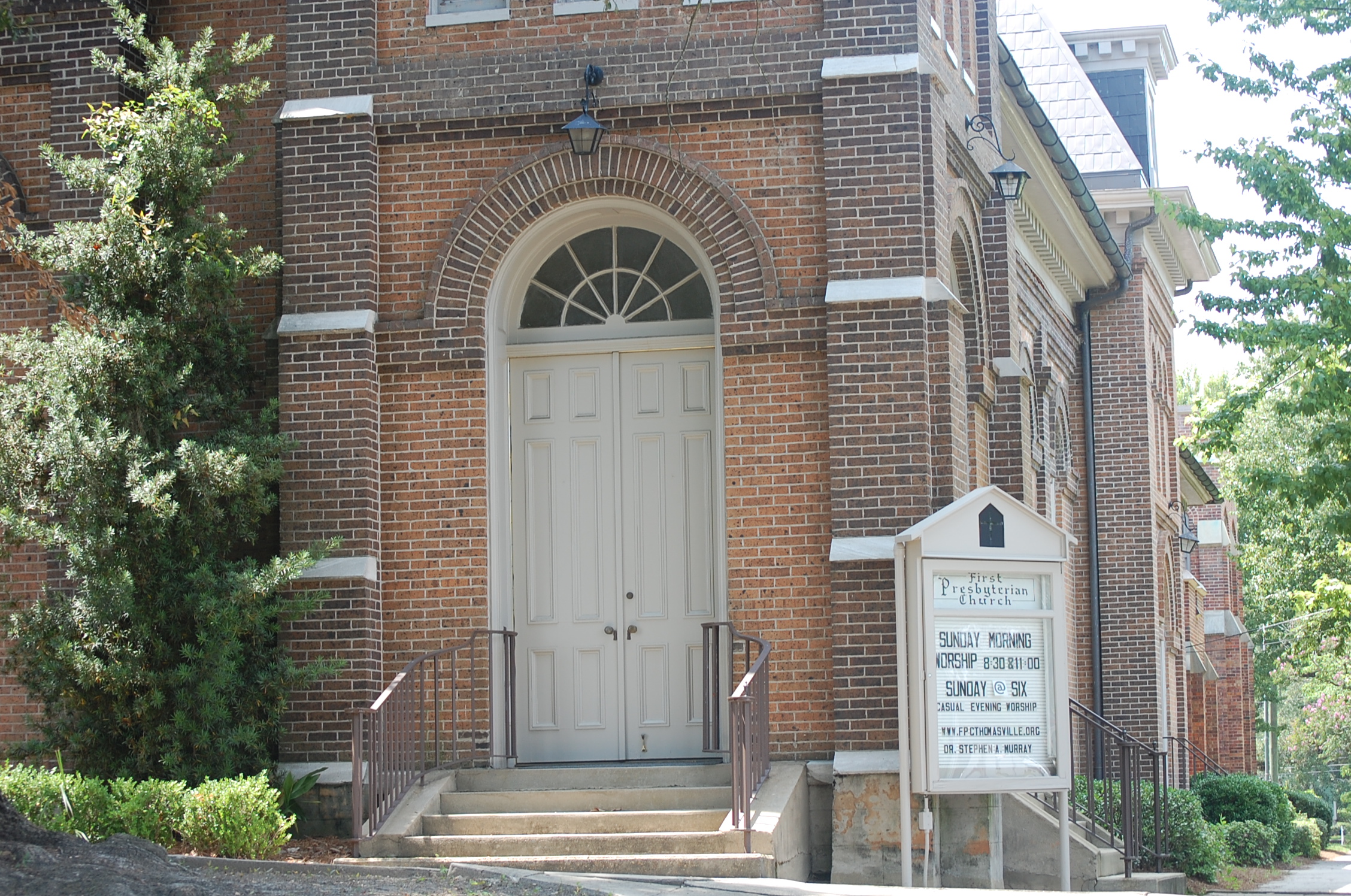
I learned recently of yet another congregation of the Presbyterian Church (USA) that has voted to leave the denomination.  This congregation is in nearby Thomasville, Georgia.  First Presbyterian Church of Thomasville has a special place in my heart because it was one of two spiritual homes during a sabbatical several years ago.

On Sunday mornings during my sabbatical I’d drive 30 miles north to Thomasville.  I’d join the congregation at St. Thomas Episcopal Church for their early service and then meander over to First Presbyterian for their eleven o’clock service.  I struck up a strong friendship with Bill Seel, who was pastor at First Presbyterian at the time.

Both graduates of Union Theological Seminary in Virginia, Bill and I were not always in agreement theologically, but we shared a love of books and ideas.  Bill became a valued colleague and friend.  We shared the Reformed commitment to “the life of the mind in service to God,” but more importantly, we broke bread together and we prayed together.

It saddens me to learn that 83% of Bill’s former congregation have voted to leave the PC(USA).  I’ve always admired this congregation’s strong commitment to mission in far-away places.  I am not privy to the conversations and meetings that led to the decision, but I’m guessing the issues were the same ones Presbyterians have been wrestling with for decades – the ordination of homosexuals, gay marriage, and the “lordship of Christ,” – all grouped under the category of “Biblical authority.”

Along with all of the “mainline” denominations, the PC(USA) is declining in membership and contributions.  That decline has much more to do with cultural shifts, the loss of de facto establishment, and the failure of the church to retain and engage its own children than it has to do with squabbles over how to read Leviticus and Romans.

Despite the efforts of some brothers and sisters to frame the sexuality debate as one between those who accept “Biblical authority” and those who reject it, the issue is not, and has never been, “Biblical authority.”   The struggle is over how to read and interpret the Scriptures as they bear witness to the living Word of God, Jesus Christ.  By and large, Reformed Christians have grounded the Scripture’s authority not in the words of the Bible per se, but in the Bible’s reliable witness to God’s Word made flesh in Jesus Christ.

So-called “liberals” do not reject the Bible’s authority.  They simply read and interpret the Biblical texts differently from so-called “conservatives.”  Just like conservatives, liberals seek to live under the Lord Jesus Christ whom they meet in the words of Scripture.  Until Presbyterians are able to accept one another as sincere followers of the Living Word, they will continue to squander precious gifts of time, talent, and money on an unwinnable debate.

Schism is hardly ever the answer.  The answer lies in loving one another, hearing one another, and working together in mission – and, of course, “in the breaking of bread and the prayers.”

SNAP Goes Justice

SNAP, the nation’s Supplemental Nutrition Assistance Program, is administered by the United States Department of Agriculture.  Popularly known as “food stamps,” SNAP is the primary vehicle by which Americans express their solidarity and compassion for hungry neighbors.  Without a doubt, SNAP is the nation’s premier tool to fight hunger.

Now that it has reconvened, the U. S. House of Representatives is considering cutting SNAP by a breathtaking $169 billion.  In a stance that I hope is naïve, but I fear is callous, some representatives are suggesting that the faith communities of our nation can take up the slack should Congress enact this massive cut.  This expectation is so far from reality, it strains credulity.

Do the math.  In order to meet this reduction in food stamps, every congregation in the country would have to come up with roughly $50,000.00 per year for the next ten years.  Here are the figures for Florida’s faith communities, complied for Florida Impact:

Religious Community

Number of Congregations in Florida

Total Adherents

Ten-Year Contribution Needed to Subsidize Proposed SNAP Cuts

United Methodist Church

768

468,080

$384,000,000

Africa Methodist Episcopal Church

453

111,300

$226,500,000

Presbyterian Church

351

127,670

$175,500,000

Evangelical Lutheran Church of America

194

68,140

$97,000,000

Lutheran Church-Missouri Synod, Florida/Georgia District

175

65,448

$70,000,000

Roman Catholic Church

 516

 2,300,000

 $258,000,000

Episcopal Church

334

129,482

 $167,000,000

Jewish congregations (including Reform, Conservative, etc.)

329

613,000

$164,500,000

Half of the congregations of the Presbyterian Church (USA), my denomination, are composed of fewer than 100 members.  Most of these congregations cannot afford the minimum salary for a full-time pastor.  Does Congress really think that every congregation can chip in $50,000.00 per year?

In these difficult financial times, food pantries across the nation – many of them run by faith communities — are reporting 100% increase in demand for their services.  Even with food stamps at their current level, families are struggling to put food on the table.  Cuts of the magnitude proposed are, to put it mildly, unconscionable.

Although they go hand in hand, there is a difference between justice and charity.  Food pantries are an expression of charity.  The SNAP program is an expression of justice.  There is no just reason why people in this land of plenty should go hungry.  It’s up to all of us – not just those of us in the faith community – to see that justice is done.


I Don’t Believe in (that) God, Either

Tallahassee Democrat writer Gerald Ensley wrote a report on some billboards that have sprouted up around Tallahassee. (Local Atheists State Their Case, Sept. 7, 2012). The billboards proclaim, “Don’t believe in God?  You’re not alone.”  As he was writing his piece, Gerald phoned and asked me for a comment.  Specifically, he asked if I found the billboards offensive.

I didn’t get the message before Gerald had to meet his deadline (I’m hard to reach on Fridays.) but if I had been able to respond, I would have said that I certainly am not offended by such a billboard.  On the other hand, I’d like to find out more about the God the sponsors don’t believe in.  It’s very likely that I don’t believe in that God, either.

On Wednesday evenings the Adult Enrichment Series at First Presbyterian Church of Tallahassee is looking at Marcus Borg’s book Speaking Christian.  Borg maintains that there are at least three paradigms for thinking about the character of God.

Photo from Tallahassee Democrat

The first is “God as Indifferent.”  This is the clockmaker God of the Deists and rationalists who takes no interest the affairs of human beings.  This concept of God produces a kind of “practical atheism.”  It doesn’t matter whether you believe in this God or not.  Basically, this God doesn’t care.

The second paradigm sees God as loving, but also as punitive and threatening.  God is seen as the enforcer of requirements, whether of belief or behavior or both.  Borg thinks that, although this idea of God is certainly based in some passages of scripture, it is not consistent with the God we know in Jesus.  It is consistent, however, with what he calls “heaven-and-hell” Christianity – the Christianity that he rejects as a distortion of the Christian faith.

The third paradigm is that of a loving, gracious, and compassionate God.  Life under this God is not about meeting requirements, but about a deepening relationship.  This God is not to be feared and appeased, but embraced and loved.

I find Borg’s categories helpful, but theologically inadequate.  He seems to miss that law in the Bible is a function of God’s love and fails to convey the richness of the gospel.  On the whole, however, I’d rather serve Borg’s “loving, gracious, and compassionate God” than the alternatives he proposes.

Some people say they believe in God, but live lives that belie that belief.  Some people say they don’t believe in God, but live loving, gracious, and compassionate lives.  The latter are closer to the kingdom of God than the former, whether they acknowledge God or not.

Not Helpful

Fools rush in where angels fear to tread.  So do candidates for high office.  During his recent visit to Israel, presidential candidate Mitt Romney ventured into dangerous territory.  In a speech to a Jewish audience he suggested that “cultural differences” are the reason Israelis are more successful economically than Palestinians.

Mr. Romney  also vastly understated the actual disparity between the incomes of Israelis and Palestinians.  He put the gross per capita G.D.P for Israelis at $21,000 and the gross per capita G.D.P. for Palestinians at $10,000.  According to the Central Intelligence Agency, the per capita gross domestic product for Israelis in 2009 was roughly $29,800.  The per capita gross domestic product for Palestinians living in the West Bank and Gaza in 2008 was $2,900.

What accounts for this dramatic disparity?  I am no economist, but I think it’s fair to suggest that the history of Israeli occupation of the Palestinian territories and the trade restrictions imposed by Israel’s government have something to do with it.  One could debate whether those restrictions are justified or not, but even a non-expert like me might be forgiven for thinking that “cultural differences” don’t tell the whole story.

What concerns me most about Mr. Romney’s comments is how they feed the anti-Semitic stereotype that Jewish people are good at making money and obsessed with profit.  The corollary of this racist attitude, of course, is that Palestinians are, by nature, lazy and unproductive.  Both stereotypes are at best uncharitable and at worst dehumanizing.

I’m old enough to remember Southerners opine that “nigras” (that was the polite term back then) were incapable of higher education and high achievement.  Looking back, I shudder to think that otherwise kind, faithful Christians could believe such bunk.  I also remember a church meeting during which an elder spoke of “Jewing down” a bid from a contractor.  He was, quite properly, chastised by his brothers and sisters in Christ.

Anyone who has been to Israel has to admire way the Israelis have brought forth the abundance of the land.  I still can’t get over the sea of banana groves near the Sea of Galilee.  On the other hand, I have Christian friends who travel to Israel to help with the olive harvest because Palestinian farmers don’t have access to olive groves that have been in their families’ possession for generations.  The point is, the Israeli-Palestinian relationship is profoundly, maddeningly complicated.

I certainly don’t have the solutions.  But I am convinced that slightly-veiled racial stereotypes are not helpful.

Broken Bones and Fractured Grammar

What a strange language English is.  Today’s New York Times features an article about an injury incurred by Yankee’s third baseman Alex Rodriguez:

Rodriguez broke a bone in his left hand when he was hit by a 88-mile-per-hour pitch in the eighth inning of a loss in Seattle on Tuesday night.

The Times didn’t get it wrong.  The bone was broken, but it was the pitcher who broke it, not the owner of bone in question.  For some reason, when a player gets beaned by an fastball, we say the player “broke a bone,” when in fact he did no such thing.  That’s just the way the idiom works. Pity the non-native speaker who is trying to master the English language.

Idioms are one thing; ignorance of grammatical rules is another.  As a former high school English teacher and the son of a college English professor, I understand that language changes over time.  The rules of grammar I was taught by the formidable Miss Whitten, the unquestioned authority in  my12th-grade English class, are evolving.

Frankly, I’ll never get used to the plural pronoun in reference to the singular subject, as in “Someone left their dish on the table,” but I understand how it avoids the use of the generic masculine.  Miss Whitten, however, must be turning in her grave.

Something up with which I will not put (Sorry, Winston Churchill) is this dreadful habit of using the nominative case for the first person pronoun when it is joined to another noun or pronoun by “and,” as in “She gave the book to Jim and I,or “Between you and I, this sentence stinks.”

People never say, “She gave to book to I,” using the nominative case.  They say, rightly, “She gave to book to me,” using the objective case.  Why, then, does adding an additional object throw people off?  I just don’t get it.  Adding more objects to the verb or the preposition doesn’t change the case.  This isn’t an example of evolving usage.  It’s an example of lazy language.

I’m not the grammar police.  I just hate to see the language mistreated.

In Praise of Ecumenical Protestants (For a Change)

Still at It

The July 2, 2012 edition of the Christian Century features an interview with David Hollinger, professor of history at the University of California at Berkley.  Dr. Hollinger has some good things to say about “mainline” churches – what he prefers to call “ecumenical Protestants.”  When asked to comment on the standard narrative of “mainline decline,” he offers a more nuanced assessment of the “failures” of liberal Protestantism:

The ecumenical leaders achieved much more than they and their successors give them credit for. They led millions of American Protestants in directions demanded by the changing circumstances of the times and by their own theological tradition. These ecumenical leaders took a series of risks, asking their constituency to follow them in antiracist, anti-imperialist, feminist and multicultural directions that were understandably resisted by large segments of the white public, especially in the Protestant-intensive southern states.

It is true that the so-called mainstream lost numbers to churches that stood apart from or even opposed these initiatives, and ecumenical leaders simultaneously failed to persuade many of their own progeny that churches remained essential institutions in the advancement of these values.

But the fact remains that the public life of the United States moved farther in the directions advocated in 1960 by the Christian Century than in the directions then advocated by Christianity Today. It might be hyperbolic to say that ecumenists experienced a cultural victory and an organizational defeat, but there is something to that view. Ecumenists yielded much of the symbolic capital of Christianity to evangelicals, which is a significant loss. But ecumenists won much of the U.S. There are trade-offs.

As ecumenical Protestants meet the challenges of ministry in the 21st century, we stand on the shoulders of leaders who understood the risks involved in putting their faith to work.  It is still the case that the church is called to be faithful, even at the risk of its own life.

Dr. Hollinger is not suggesting that numerical decline is something to be desired, or that the loss of members is entirely attributable to the struggle for justice.  Still, he provides a welcome perspective.

There are those who say that the mainline denominations have lost members because they departed from Biblical principles.  I think that many factors have contributed to the current situation; one of them has been faithfulness to the God revealed in the Bible.

Why Care for Creation?

Tallahassee’s Second Largest Solar Voltaic Electric Plant

Let’s start with three basic theological principles.

  1. “The earth is the Lord’s, and the fullness thereof” (Psalm 24).  Theologically speaking, we human beings don’t own anything.  We’re merely stewards – caretakers – of a creation that belongs to the Creator.
  2. As wonderful as the creation is, it has its limits.  We cannot exploit the earth’s resources with abandon.  When we do, we disrupt the balance God built into creation from the beginning.   That, more or less, is the lesson Adam and Eve learned when they ate the forbidden fruit.  Without limits, the whole system goes haywire.
  3. Human beings are made in the image of God to live in community with one another.  The answer to the question, “Am I my brother’s keeper?” is “Yes!”  We cannot love God without also loving our neighbors.  I cannot honor God without honoring God’s image in my neighbor.  Hence, it’s not enough for me and mine to flourish.  I must see that my neighbor flourishes as well, living in dignity, freedom, and justice.

These basic theological principles prompt a moral mandate to care for the earth not merely for our own sakes, but also  for the sake of others.  Environmental stewardship is not just a choice.  It’s  a “vocation ”  — a calling, the will of God for humankind.

As simple as these concepts are, they are easily forgotten, even by Christians, who ought to know better.

While I’m happy to see corporations jumping on the “Green” bandwagon to market their products as “sustainable,” and while I support governmental regulations to limit the unbridled exploitation of the earth’s resources, I don’t look to market forces or to regulation to get us out of the mess we’re in.  What’s required is what Christians call “repentance”  — moral realignment – a purposeful change in the way we live our lives.

That realignment must begin with communities of faith.  We can’t very well expect others to change their lives if we’re not willing to change our institutional lives first.  My own congregation came to that conclusion four years ago when we committed to reduce our “carbon footprint” to zero.

We began by retrofitting our 1950’s-era Education Building with double-paned windows and modern fluorescent fixtures.  Then we tore off the old roof and put on a new one, aligned to get the maximum benefit from the sun’s rays.

Next we installed a solar voltaic generating plant on the roof, following the example of the Unitarian Universalist Church, the first congregation in town to install solar panels.  Our 25.5 KW panels produce about 25% of our total electrical needs.  When we’re not using all the electricity the sun generates, our meter, in effect, runs backwards, and we sell the surplus back to the City.  Since it was installed, the system has avoided the production 235,580 pounds of carbon dioxide and saved enough energy to power eight homes for one year.  (For a real-time readout, click here.)

The next-to-last step was to renovate our sanctuary, built in 1838.  We replaced our venerable air conditioner with a state-of- the art system and retrofitted the entire building with the most efficient lighting systems we could find.

We did all this not to save money.  (The project cost a great deal of that!).  We did it to be better environmental stewards.  We called the project “Light from Light,” borrowing a phrase from the Nicene Creed. A final step remains. When we’ve saved enough money, we’ll modernize the HVAC system in the Education Building

Having reduced our carbon footprint, we asked a partner congregation in Frenchtown if they knew folks who needed to make their own homes more energy efficient.  When invited, we went into homes with caulking,  CFL’s,  low-flow showerheads, window film, and other accoutrements to make our neighbors’ homes more energy efficient.  In future years we plan to contribute to Sustainable Tallahassee’s Community Carbon Fund.

Other congregations are making similar life-style changes.  I applaud these efforts.  We preachers can huff and puff all we want about the need for environmental repentance, but repentance starts at home.  Unless communities of faith live out our calling to be stewards of creation in our own institutional lives, our words will be no more than “a noisy gong or a clanging cymbal.”