Fundamentally Speaking

Agnostic Clarence Darrow and Presbyterian William Jennings Bryan at the Scopes Monkey Trial

Fundamentalism comes in all shapes and sizes.  I’m most familiar with the Christian variety, but there are other forms as well.

Recently the Presbyterian Church (U.S.A) changed its constitution.  We removed language that functioned as a bar to the ordination of Lesbian and gay officers (ministers, elders, and deacons) and replaced it with language that states: “Standards for ordained service reflect the church’s desire to submit joyfully to the lordship of Jesus Christ in all aspects of life . . .”

This seems to me to be  a very high standard.  You’d think that submitting to Jesus’ lordship in all aspects of life would be challenge enough.  Some brothers and sisters are not happy about this, however.  One session (local governing body) wrote to Florida Presbytery:

We cannot mold scripture into something it is not simply for political or cultural whimsy, nor can we pervert it to accommodate sinful behavior without fear of impunity.  It is imperative that our church clarify in a righteous manner by putting into practice the teachings of the Bible as it pertains to fidelity and chastity for all leaders of our church.  We believe in the infallibility of the Bible and sacred truths it teaches us, both the Old and New Testaments, where we learn that these sins are clearly not the intended design of God’s perfect creation for a man and a woman.

(I think the writer meant either “without fear of penalty,” or “with impunity” but, you get the drift.)

Fair enough.  Don’t tamper with an infallible Bible.  The problem is, the Bible endorses lots of practices that modern Christians reject (beating your wife, killing your children for disobedience, polygamy, Levirate marriage) and forbids others that modern Christians accept (wearing clothing of differing cloth, touching women while they are menstruating, getting tattoos, divorce).

A little interpretation is called for, isn’t it?  But we tend to be rather selective in our interpretation.  Some bits of the Bible we keep in the file folder marked “infallible” and others get filed under “no longer applies.”  Clearly, the writer of the passage above thinks the Bible contains a blanket condemnation of sexual intercourse outside the marriage of one man to one woman.  The fact that it does no such thing is irrelevant.  We must stick to the fundamentals.

There’s also a political form of fundamentalism.  For the majority of the Florida Legislature, capping tax revenue is fundamental.  Thus, if  lawmakers manage to pass a bill requiring internet giants such as Amazon to collect sales taxes, the Governor won’t sign the  legislation unless it’s “revenue neutral.”  Whatever the right hand collects the left hand has to give back.

In other words, the State can’t possibly bring in more money for Early Learning, healthcare, or education, even if it’s money already owed under current law.  “No new taxes”(or even old taxes collected from internet deadbeats).  It’s fundamental.

I recall a bumper sticker:  “The Bible Says It. I Believe It.  That Settles It.”  Replace “The Bible” with “Grover Norquist” and you’ve got a bumper sticker that would sell like hotcakes.

Life among fundamentalists will always been challenging, no matter where you find them.

Lord, Forgive Us Our . . .

There are some pitfalls in this brave new world of social media.  One of them is the fact that when I make a blooper, it is exposed not only to the flock (who are used to my many shortcomings) but also to the entire World Wide Web.

For the past few weeks I have been posting this column as a blog post.  As typos go, the ones in last week’s column were real howlers.   Instead of “Pig in a Poke,” I typed “Pig in a Polk.”  As if that were not bad enough,  I left out the “l” in “public” when referring to “public policy.”   This is more than a little embarrassing.  I don’t really want to get into that particular conversation online.  I get enough unsolicited e-mail already.

I figured out how to fix the blog post, but the newsletter went out uncorrected.  I offer thanks to the many of you, both in the congregation and out there in the ether, who caught the typos and let me know about them.  Humble thanks, of course.  In the circumstances, I could hardly offer any other kind.

This puts me in mind of a young pastor in my grandparents’ church in Coahoma, Texas.  Not long after arriving in that community of cotton farmers, he offered a pastoral prayer imploring the Lord to bless the “hoers in the field.”  He hadn’t quite cottoned onto the local lingo.  Every parishioner who shook his hand after worship whispered, “It’s hoe hands, Charlie, not hoers.

On another occasion Charlie prayed, “Lord, forgive us our falling shorts.”  Not quite the same thing as the Book of Common Worship’s “shortcomings and offences.”  I’m sure the Lord knew what Charlie was talking about, but the image evoked by his rough equivalent is likely to have left the congregation rather distracted.

Baggy pants are a fashion statement these days, but falling shorts are another matter.  (Come to think of it, the former might well contribute to the latter.)

Typographical errors, as bad as they are, are not quite so embarrassing as liturgical ones.  In by first parish I began the Easter morning liturgy by shouting “Christ is born . . . I mean . . . risen!”  It was not my proudest ministerial moment.

Humility is desirable in my line of work, but if you’re me, it’s unavoidable.

Courage Today

My son Adam gave me the new biography of Dietrich Bonhoeffer by Eric Metaxas for my birthday.  At 542 pages, Bonhoeffer: Pastor, Martyr, Prophet, Spy made  for good reading at the beach following Christmas.

As Metaxas guided me through those chilling years of Hitler’s rise and the ever-increasing persecution of Jews, I kept asking myself, “If I had been a Christian in Germany at that time, what would I have done?”

Would I, like Bonhoeffer and that small band of pastors in the Confessing Church, signed The Theological Declaration of Barmen, rejecting “Nazi Theology,” or would I, like the vast majority of “good” Christians, gone along with what was termed “German Christianity?”  Metaxas points out that many,  many Germans opposed the Third Reich, but felt it their patriotic duty  to serve in the military and not to resist the government openly.

Last Sunday Glenda Rabby gave a wonderful talk to the Inquirers’ Class at First Presbyterian Church, Tallahassee, about the role of churches and church leaders during the Tallahassee Bus Boycott and the Civil Rights Movement.  I was too young at the time to make adult decisions, but I remember the pressure my father faced as a pastor in Texas.

When Dad stood for Civil Rights, even in a modest way, he was vilified by some church members as a Communist dupe and a disloyal American.  Members of the John Birch Society came to our church and took notes during his sermons to make their case against him.  My parents received anonymous phone calls at the manse accusing them of being “nigger lovers.”

If I had been the pastor of a church in the South in those days, would I have had the courage to speak out?  To march with Dr. King?  To insist that racial segregation was contrary to the gospel?  To drive black voters to the polls?

In hindsight, the issues facing Christians in the 50’s and 60’s seem crystal clear.  At the time, however, things seemed more complicated.  The same is true today.

Leon County Supervisor of Elections Ion Sancho has become a voice crying in the wilderness regarding the recent restrictions on voter registration and early voting passed by the Florida Legislature  He told  a crowd on Martin Luther King, Jr. Day,

We are facing a time that few of us thought would be possible.  History tells us we have been here before.  (The legislators) have another plan they want to implement, to make sure the people who voted in 2008 are not the same people who voted in 2012. (Quoted in the Tallahassee Democrat, January 17, 2012)

The argument that the new restrictions are merely a hedge against fraud by voters is an obvious sham.  It requires a willing suspension of disbelief to see the new law as anything but a means of suppressing votes by those who traditionally vote Democratic.  The effect of the law is to limit the votes of blacks and other minorities.  The law is not overtly racist, but then again, neither were the old poll tax laws.  These days you don’t have to be Bull Connor to keep non-whites from voting.

Preach on, Brother Ion!  You are a profile in courage.

Turning the Tractor

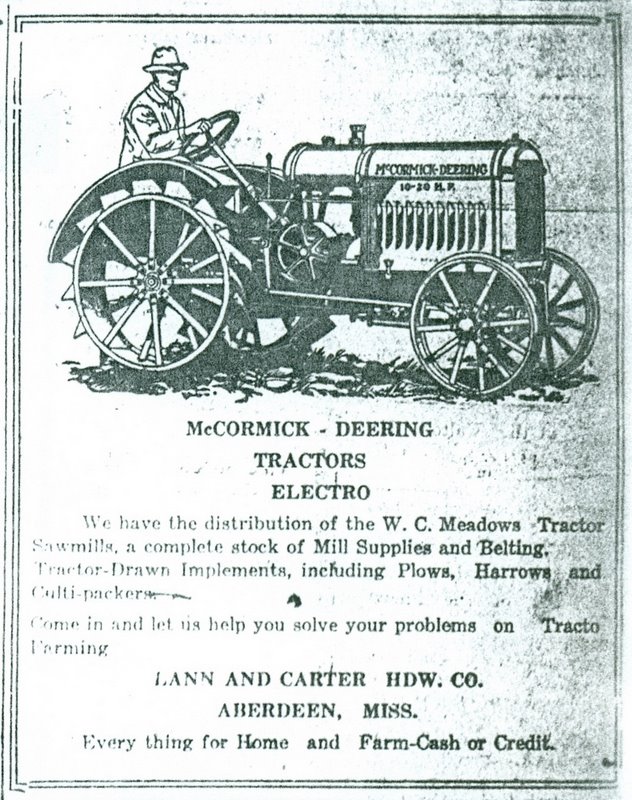
Frank Loveless was born in 1901.  He grew up in Spade, Texas, which is less than a wide spot in the road; it’s just a junction were farm roads intersect.  When Frank was a 16 years old, he was working his father’s cotton field with a horse-drawn plow when a tractor salesman appeared.  The vendor was driving a truck and towing a trailer on which was perched a brand new McCormick tractor.  He backed the newfangled thing off the trailer and asked Frank if he’d like to give it a go.

Frank had never driven a tractor.  I’m not sure he’d ever driven a car.  He climbed up on the contraption and started down the row of cotton he’d been working with his horse-drawn rig.  When he got to the end of the turn-row, he pulled back hard on the steering wheel and yelled “Whoa!”

The tractor, obviously hard of hearing, continued on its course, crashed through the barbed wire fence and came to rest in a ditch.  Steam gushed from the punctured radiator.

The salesman managed to the tractor back on the trailer and drove away.  Frank went back to his horse-drawn plow.  So much for technology.

Frank Loveless was my grandfather.

Although I’m not exactly a Luddite, it’s clear that I am not genetically predisposed to technological innovation.   My son Adam has been blogging for years.  He must get it from his mother’s side of the family.  It was Adam who convinced me to enter the blogosphere,  and I do so with considerable trepidation.

For one thing, I’m not sure I have to time to keep this up.  For another, I have serious doubts that anything I would write would be worth reading.  Most of all, I fear that, having expended my full allotment of words on a weekly sermon, I won’t have any left for a blog.  Or at least no words worth posting.

Oh well, I’ll give it a go.  I can always go back to the horse.